Open top menu
Showing posts with label Ferrari. Show all posts
27 May 2013
The continuing FIA/Pirelli/Mercedes Tyre testing debacle

Having reported briefly on the subject yesterday both Red Bull and Ferrari lodged a protest against Mercedes before the Monaco GP commenced. 

Post Race, members of Ferrari, Red Bull, Mercedes & Pirelli were called in front of the stewards in an attempt to resolve the situation.  As I said yesterday in reality it's a problem that really shouldn't be raised at a race weekend but with such high media coverage available to Red Bull and Ferrari the prospect of causing a furore is an opportunity best not missed.

So what do we know?

Article 22 of the Sporting Regulations prohibits in-season testing with the exception of 4 days of straightline or constant radius tests and 8 promotional events (Limited to promotional tyres and 100KMS per event).  The other option is the three day young driver test but must be carried out on a date and track approved by the FIA.

Pirelli approached the FIA to ascertain if they could invoke a clause in the contract between the two parties to test a contemporary F1 car in order to aid in tyre development.

The FIA agreed to Pirelli's requests, with the understanding that all 11 teams were given the opportunity to complete the same test.  They also requested that Pirelli's team conduct the test, using the teams cars to establish some level of parity.

Pirelli state they offered the test to teams others than Mercedes but have not explicitly confirmed it was offered to all teams. According to Pirelli this is not the first time the tyre manufacturer have made such an offer either. 

The test took place in the week following the Barcelona GP and was conducted using a 2013 Mercedes AMG W04.

The team covered around 1000KMS during the 3 days they run around the Circuit de Catalunya

What don't we know?

Who was driving the Mercedes W04 during the tests? the use of any Mercedes drivers or test drivers being ruled out by the FIA in their requirements to holding the tests.

What Tyres were tested? Ross Brawn told us his team weren't made aware what tyres were being tested and only had the codes made available to them.  This means that Pirelli could have been testing anything from 2011,2012,2013 or any number of combinations of these and plausibly prototype tyres for the rest of this season and/or beyond.

Corners of the media have questioned if Mercedes took the opportunity to test development parts or setup whilst conducting the tests.  In an interview with Sky Sports however, Ross Brawn stated the team didn't conduct any of their own tests but instead completed a continuous program outlined by Pirelli.

We can safely assume that the FIA weren't present at the test as they continue to deny knowledge that it took place.

Ferrari have reportedly conducted a similar test after Bahrain (Although the circuit it was conducted at also remains a mystery) Ferrari however made their 2011 challenger (F150) available to Pirelli to conduct the test.

The use of Ferrari's F150 would certainly assist in the correlation between it and their own test car (Renault R30 from the previous year).  What it fails to do though is help Pirelli establish a connection to their modern counterparts.  I'd be interested to know what specification F150 they ran too, with Blown Diffuser's and Off Throttle Blowing coming to prominence in 2010/11 their own test car doesn't sport a Blown Diffuser or the necessity to blow Off Throttle. The F150 may have given Pirelli more of an inkling into the downforce levels and aero issues associated with this and the 'Coanda' style exhausts currently being used in Formula One.

Having therefore established the aerodynamic inefficiencies of using their own R30 when correlated against the Ferrari F150 (Discussed further in my previous article: Pirelli - Are they really to blame?) it would appear Pirelli sought to establish a direct link by virtue of using a 2013 car.  Afterall everyone is looking to Pirelli to supply a tyre that suits their requirements, but without the necessary tools with which to do so.

EDIT - My Twitter pal @PiusGasso has provided some images of the F150 (2011 Challenger) being used at the reported Ferrari tyre test. 


So if other teams were invited to test, why didn't they?

Data: The holy grail in modern F1, tests carried out by Pirelli in a controlled environment would lead to a data set that if made available to the teams could lead to disastrous consequences.  I'm not saying that Pirelli would allow this data to be made available in the public domain but it doesn't stop it being leaked and I'd imagine some of the teams had this in mind when they declined.

Where do I see things going from here?

The FIA's note to the media: http://www.fia.com/2013-monaco-grand-prix-note-media all but confirms the issue will be raised with the WMSC.  At the end of this no-one will come out of it a winner, if they decide to side with Pirelli/Mercedes the other teams will remain aggrieved, believing Mercedes have gained an advantage for the rest of this season.  If Mercedes are found to be guilty of deliberately circumnavigating the regulations numerous penalties could be implemented.  The result of yesterday's race however will always remain, the points issued however could be revoked.  Just as an exclusion from forthcoming races and/or exclusion from the Championship could ensue.  It's the severity at which the council find the rule break as to how a punishment is levied but they must also be careful (in my opinion) not to go to far.  Financial punishment to a company like Mercedes however would not sit well with the other teams and so I do see a penalty, if forthcoming being a point deduction or expulsion.

Pirelli also find themselves caught in the crossfire once more and whilst the tyre manufacturer are still crossing the T's and dotting the I's on a new contract this further puts their decision to continue supporting Formula One in jeopardy.

Moving Forward.....

The problems faced by any tyre manufacturer considering Formula One as a series to promote their product is relevance (the reason Bridgstone quit), helping to aid the show (the reason Pirelli got the current gig) and image (the reason Michelin withdrew when we had the Indianapolis debacle).

Pirelli have struggled this year with the need to rectify certain design issues with their 2012 tyres whilst balancing the requirements to produce a tyre that will result in a 2 to 3 stop strategy.  My article previously mentioned above shows the problems the teams have had with the aerodynamics of the 2013 tyres and moreover the scale model tyres given to the teams by Pirelli.

Pirelli have always been pretty vocal about their need for a representative car in order to test their tyres but in reality with how fast F1 moves with upgrades available at every race at GP's the only effective way for this to happen is for them to run their own car development program ( I know myself and ScarbsF1 are free if you're listening Pirelli ;) ) or use a spectrum of current teams cars.

2014 is going to be a pivotal year for F1 with a shakeup in terms of both Aero and Powerplants, causing the teams headaches already.  Add to this the potential for Pirelli or any other manufacturer brave enough to enter F1 the challenge of designing a tyre with a Goldielocks syndrome (Not too aggressive or too conservative). 

All I know is that someone will be unhappy, whatever the outcome and parity cannot be restored even if all the teams now went and completed a 3 day test at the Circuit de Catalunya with the same program that the Mercedes team ran.

Related articles
Enhanced by Zemanta
Read more
6 May 2013
no image

The first 4 races of 2013 have been what we would term 'Flyaways' we use this term as the teams are all based in Europe but these races are on another continent. When F1 returns in Barcelona it will be off the back of a 3 week break, but whilst the TV camera's have stopped filming the action, work still continues in the factories on gaining performance on their rivals.
Read more
16 Feb 2013
Interesting features from Jerez Testing

The first 4 day test at Jerez was conducted and concluded a week ago and now the teams will descend on Barcelona in the next stage of their pre season tests, starting on 19th until 22nd February. As we all know it is difficult to conclude from the times set any concrete evidence of where the teams will match up this season. The times we see aren't representative due to many factors including fuel load, tyre life/degradation, powertrain conservation and general setup work.

I'd like to look at some of the interesting features we saw during the Jerez test that weren't present/obvious on the launch cars:

Red Bull and Lotus Tea Tray Support


Both the Renault powered cars have implemented changes in this area which as we know is key in the way in which air is moved downstream to the diffuser. I'm not strictly insinuating that their supports have anything clever going on, however as the area is changed from their 2012 design I feel it's worth mentioning.

Ferrari Nose Hole

Above: Nose used during Days 1-3 at Jerez

Above: Nose used Day 4 of testing at Jerez allows us to see an exposed duct in the F138's bulkhead

Above: Mario has kindly allowed me to use his illustration of the nose that features the larger cooling aperture

Having stepped out of the drivers seat Massa remarked that the car is a clear improvement over the early version of the F2012. He did however highlight the fact that driver cooling needed to be looked at. In this respect of Day 4 whilst in the hands of Pedro De La Rosa the team furnished the F138 with a new nose that revealed a much deeper and wider hole under the belly of the F138's nose. Speculation has and will continue in regard to the holes true purpose but the fact remains it's primary function is driver cooling.

The holes size in comparison to the aperture on it's predecessor and other cars using such a placement has many speculating further ramifications from it's placement. The size of the inlet could assist in the cooling of electronics and/or KERS aft of it whilst others have speculated that it's appearance could result in the team harnessing it's aerodynamic placement for other purposes such as DRD.
The nose of the F138 has been further raised from the position utilised on the F2012 and so it could be argued that the holes introduction could also aid in the drawbacks of the extended surface area under the nose (Boundary Layer Buildup) a change in profile in this region could mitigate further reaching airflow enhancements further down the car at the Sidepods.

McLaren Turning Vanes


McLaren opted for a very neutral design in this area last season following their adoption of the higher nose tip from Mugello onwards and I often wondered if there was a gain to be had by being more adventurous. Through their adoption of a Vanity Panel in 2013 the team have raised the nose of the MP4/28 further than they did last season and with this even more air is driven under the car. To control and manipulate the air under the nose the team have installed a pair of three tier Turning Vanes much like the two tier ones we have seen used by Red Bull and Ferrari in the past.

Lotus & Mercedes DRD


Lotus investigated the merits of DRD in the middle of the 2012 season and later shelved it, prefering instead to concentrate on a Semi-Coanda exhaust layout instead. The team have already stated that they will once again assess it's merits for 2013 and started doing so (if only very briefly) on Day 4 at Jerez. We do however know by the mere fact that the Airbox 'Ear's still adorn the E21 Chassis that this claim is serious and I suspect more work will be done in the forthcoming tests at Barcelona. In a contrast to their 2012 version the brief showing of DRD on the Lotus showed them with a revised Periscope. Previously their Periscope had met with the Mainplane whereas this new iteration (Like the Mercedes variant of 2012) finished short of the Mainplane.
However I'm not completely convinced this was Lotus showing their 2013 version as we can see they were missing the trailing part of the Engine Cover, Outlet Exhaust and Monkey Seat arrangement. Furthermore on close inspection of the Periscope no blow holes are present. So I look forward to seeing what the team test in Barcelona.
Mercedes also tested DRD during Free Practice sessions in 2012 and have revisited it's application in 2013 when they fitted it during Day 4 at the circuit. The W04's version of DRD featured a Periscope design like the Lotus E20's reaching all the way to the mainplane.
Read more
14 Feb 2013
#TechF1 Show - Under Nose Ducts & 'S' Ducts Explained (Sauber, Red Bull Racing & Ferrari)

In this brief video I have a look at a feature started by Sauber last season (C31) and carried across to their new design.  Red Bull have also adopted an S Duct within their design this season whilst Ferrari are using a duct underneath their nose for additional cooling and to tidy up the Boundary Layer being produced under the nose. (Boundary Layer = Formation of slowed airflow over an extended section of bodywork) By intersecting the point at which the Boundary Layer starts to form with a change in surface the slowing of airflow isn't as rapid.


Read more
2 Feb 2013
Ferrari F138 Technical Launch Analysis


Ferrari announced earlier in the week their 2013 challenger would be designated F138 (13 for the year and 8 denoting the last year F1 uses the V8 engine configuration)
Its been well documented that Ferrari's problems last season were compounded by correlation issues with their Wind Tunnel. The team realizing this have set about updating their facilities in Maranello and shifted design focus for this challenger during last season to the Toyota facility in Cologne.

The F2012 had been muted to be an aggressive design leading upto it's launch last year. The car featured a step nose much to the annoyance of many of their fans but more importantly at the front of the car pull rod suspension.
It became apparent early on that Ferrari had made some design decisions that may impinge on their performance. The Sidepod layout featured a return to upright radiators meanwhile their exit at the rear of the car exited in combination with the exhaust plume. Ferrari's solution was trying to pull the airflow through the Sidepod and create more flow over the rear of the floor.  The team swiftly set about changing their exhaust position running many different versions of their Acer duct before settling on a more McLaren inspired external exhaust.

Alonso's championship assault was mirrored by Ferrari who were aggressive in their application of upgrades. These didn't always and get raced as they continued to struggle with scale and CFD correlation with quite a few front wing designs falling on the scrap pile.

The F138 launch images perhaps show the closest car to what the a team will test with so far, plenty of detail changes when compared to the F2013.  Starting with the Front Wing the top flap's inner section has been split into two sections much like other teams started adopting last season.  This increases the co-efficiency of the section whilst also setting up the airflow aft of the wing better.  As per 2012 the team continue to have a stacked wing effect at the outer portion creating 6 elements


In side view we can see the Endplates complete the same structure as the F2012 helping to maximise the 6 tiers working on the Wing elements inside of them.  The nose just like McLaren takes the height rules to it's limits allowing more air to be driven under the car.  Utilising the vanity cover allows the nose tip to be placed even higher allowing more clearance underneath, with the nose tip so high the team have decided to offset the Wing Pylons by graduating them rearwards meaning the frontal area is maximised and the pylons themselves extended further back to aid in controlling the air further downstream.


The image below shows how high / flat the nose meanwhile the team show their under nose turning vanes to be similar to last years.  The Pull Rod Front Suspension used by the team in 2012 has been re-designed in order to make working on the car easier for the mechanics.


Moving down the car to the Sidepods and the 2012 ethos appears to have carried across to the F138, without the bodywork off I obviously can't confirm it but it would appear that the team have stuck with their vertically mounted radiator layout rather than returning to the slanted layout (Signaled by the abrupt bodywork curves in that area). The Inlet remains relatively unchanged as do the Vortex Generating fins next the to the cockpit entry and the twisted twin element Sidepod Airflow Conditioners.  The bargeboard features a less aggressive design with the serrated edges missing at present.  The roll hoop remains unchanged in design as does the duct behind. 


At the rear of the car the launch images show the F138 sporting the semi-coanda exhaust just as they did through the 2012 campaign.  Ferrari like McLaren and Force India have also adopted the integration of the halfshaft into the lower wishbone as I talked about alot (sorry) last season as a concept Adrian Newey's lineage of cars from the RB5 have used.  This allows the wishbone to be placed higher whilst also removing the aerodynamic effect the halfshafts rotation has on the exhaust plume.  Like Red Bull it would seem that Ferrari have also placed a couple of vertical strakes underneath the wishbone in order direct the plume over the diffuser.  It would appear that Ferrari have also taken the opportunity to lengthen the gearbox area to further take advantage of the exhaust plume manipulation in the coke bottle region.
The team have retained their outer floor slots just in front of the rear tyres but I suspect as the team extract more performance from the exhaust and enable airflow to seal the floor between the tyre and floors edge these will become redundant.  Further modifications have been made to the rear brake ducts with holes cut into the top edge increasing it's efficiency.

Lastly and perhaps most radically are the Rear Wing Endplates which feature slats at their rear, I will look into these further to assess their true purpose but just like the strakes we see adorn the bottom of the endplates on most cars these slats will manipulate the airflow ahead of them.  My initial thoughts lead me to believe they are using these in order to enhance the diffusers effect.


The lack of cooling at the rear of the car clearly signals this isn't the complete story from Ferrari and just like their rivals I suspect they will test with a different exhaust design.
Read more
31 Oct 2012
India GP Technical Roundup (Ferrari & Red Bull)

Ferrari

Ferrari have been testing many Front Wings over the last few races so it was no surprise they arrived in India with yet another iteration. 


The main Wing differs only in small details from its predecessors but the Endplates offer an alternative arrangement for the holes.


The team also arrived in India with a new diffuser arrangement featuring a section in the central portion that allows the starter holes airflow to exit higher up.  This is not revolutionary and a more aggressive version has featured on the Mercedes W03 for some time.


Alongside the Diffuser amendment it was presented with a new Gurney Flap.  The Gurney extends down around to the bottom edge of the Diffuser where as the old one stops short and had more of a bulbous section as it curved around the top edge.  (The new Diffuser Gurney is very similar to the one McLaren ran earlier in the season and have since switched to one very similar in design to the outgoing Ferrari one)  As we can see in the picture below they have still opted to use a 2 tier Gurney just as Red Bull are employing.

Above: New Diffuser Gurney extends around the whole of the Diffuser

 Above: Old Diffuser where the Gurney didn't come all the way around the edge

Both drivers did back to back tests with the Diffuser during the practice sessions but as only one was available at the circuit Fernando went on to race it.

An area where the team have stepped back is the cockpit fins, the team have been running for a number of races the foremost fin as part of the Mirror Stalk. In India the team reverted back to old fins under the mirrors.


Red Bull

In India the team once again revised the cars but this time chose to run their drivers with a minor difference.
Mark ran with different Sidepod Airflow Conditioners, unlike the ones on Seb's car and that have been run all season these Conditioners connect to the Sidepod at a lower point whilst Seb's arch over creating an airflow frame much higher up the Sidepod.


The Conditioner's on Seb's car are pretty much the same design used since the start of the season and so it's unsurprising the team would look to develop this area.

I looked back last week at Red Bull's update path over the last few races and chiefly the alterations made to the Front Wing and Nose. I also looked at how the team had revised the length of the Sidepod in order to extract more Exhaust/Aero performance: http://somersf1.blogspot.co.uk/2012/10/red-bull-recent-development-analysis.html 

If we were to look back at my comments on the RB8 after Spa and Monza (http://finalsector.co.uk/tech-roundup-low-downforce-special-spa-monza/) we would see that I eluded to the Tunnel concept choking, as too much airflow overwhelmed the area's the Tunnel's were sending airflow to.

In the pictures below from Italy & India we can see the different ethos employed around the outside of the lower engine cover exit.


This airflow is received from the smaller more rearward Tunnel and was initially aimed squarely at the Starter Motor Hole (SMH) With the Starter Motor Hole being overwhelmed by airflow the airflow was causing the SMH to stall affecting the diffuser's performance, meanwhile the airflow that couldn't penetrate the SMH tumbled off causing a more widespread diffuser inefficiency.

Above: Great Illustration of the Red Bull Cross-Under Tunnel by Craig Scarborough the full article pertaining to this diagram can be found here: ScarbsF1 - Red Bull Ducted Sidepod & Blown SMH

With a wider reaching outlet now in employment it allows the SMH to receive airflow but as the floor is scalloped out around the sides of the SMH and Crash Structure a much more laminer and constructed flow pattern emerges which isn't degraded or overwhelmed by an exponential increase in speed. This allows the Exhaust plume to flow between the Driveshaft Cowl / Floor Strakes unimpeded by an erant flow structure leading to an increase in downforce and better overall balance.

As always it must be pointed out that Red Bull are still the only team to have employed the Driveshaft Cowling / Floor Strakes in 2012 in an attempt to control the airflow in this region. Although the team have made many revisions to the design of their Exhaust solution during 2012 this feature has remained constant and plays a large part in the efficiency of Exhaust Plume control for Red Bull.

In this last shot we can see that the team also painted flo-viz around the Exhaust Ramp/Engine cover at some point throughout the weekend. This was probably to assess the effect of the New Vertical Floor Strake position we can see being used in the picture below. The Strake reaches in more towards the ramp aligning with the outer part of the exhaust channel acting as a Vortex Generator at the edge of the floor further helping to 'Seal' the edge of the diffuser. The previous Strake was perpendicular to the outer rear edge of the floor.


Read more
3 Oct 2012
The Flexi Front Wing debacle continues

When we think about flexible Front Wings our thoughts initially turn to the wings that Red Bull used during 2010/11 to gain a performance advantage.  The FIA made the Front Wing load tests more stringent after many teams attempted to replicate the Red Bull's design, failed and so the FIA leveled the field by making the tests more stringent.  Ferrari's ill fated flexi wings didn't offer the correct torsional stiffness and regularly failed as seen when the ends began to flutter under load.

The idea behind these type of Flexi Wings was that the outer section of the wing would droop to the floor when under load.  This helped to navigate the airflow inbound rather than losing some of the flow laterally around the outside of the wheel.

McLaren were one of the teams that failed to assimilate the Red Bull's design in full but have since then been running with a Front Wing that does flex just in a different way.  The McLaren Front Wing flexes under load but when doing so the whole outer portion of the wing tilts backwards.  The reason for this is that as downforce exponentially increases with speed so does drag.  By having the wing planes / cascades tilt backward at a speed threshold you reduce both downforce and drag allowing the car to attain a top speed easier.  Design of the whole region with this in mind will also allow for more airflow to be sent inbound which is crucial this year without EBD.

Red Bull's new Front Wing in Singapore is reportedly designed with the same 'lean back' style aero advantage that McLaren have been utilising for some time which has lead to Ferrari requesting the FIA look into their designs.

Although I don't see these Wings being outlawed in Suzuka the FIA may adjust the load tests in forthcoming races in order to reduce their affect.  But as with the original Flexi Wings it will more than likely entail a re design of the Front Wing Pylons too.

(EDIT - Before Suzuka, a 1000N (approximately 102kg) load test was applied to an area of the front wing 790 mm forward of the front wheel centreline, and 790mm from the car centre line. The wings are allowed to deflect just 10mm. For Suzuka the FIA has tweaked this and is now testing the area 675mm forward of the front wheel centreline)  All Front Wings passed the new FIA tests but it's not known if any of the teams made adjustments beforehand as they knew the tests could be altered.

Front Wings are crucial in the flow structure this season due to their effect downstream with EBD banned it's vital to get airflow moving toward the rear of the floor.  This is why we have seen teams using the FOM TV camera's in a position between the Front Wings pylons behind the central portion of the wing that is mandated.  This positioning helps to affect an area of airflow that normally can't be affected.

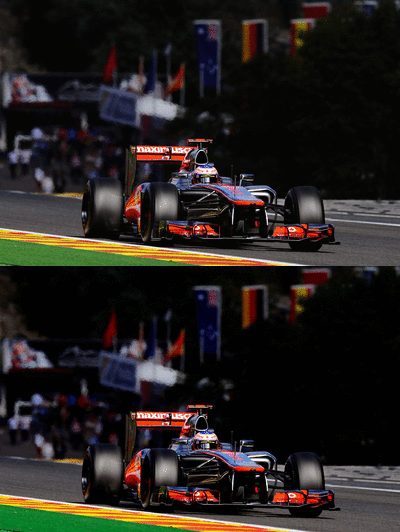
Above: In this image from Spa we can see that the Front Wing on Jenson's car is leaning back under load


In the image above I've rotated the Endplate in order to show you how this rotation may appear (obviously the effect is much more graduated under load / speed and the whole wing section will rotate but I can't show this easily)
Read more
22 Sept 2012
Gurney Trims, Tabs or Flaps and why they're important for the Diffuser in 2012

A Gurney flap is so named after Dan Gurney who first applied such a device to the trailing edge of the rear wings of his car's in the 70's. This was not a new concept however and has been used in flight applications since the early 1900's in order to make a wing create more lift to the deficit of more drag.

The Gurney is quite a blunt method of producing lift/downforce but can also help to rectify deficiencies in the wings design. It helps to trim the angle of attack of a wing thus allowing a higher angle of attack before separation occurs. In terms of flight, had a designer miscalculated the design profile of his wing adding a gurney may help to rectify the flight pattern, as such the same can be done with an F1 wing. The advantage of this in terms of motorsport is that you can continue to leverage more downforce from a wing by increasing the wings angle of attack, however by default this will create a larger proportion of drag. This is caused by the airflow on the rear of the wing being unable to sustain the same AoA and so separation occurs as the boundary layer increases at the trailing edge.

The FIA regulations mandate the height of a Gurney Flap be no more than 20mm on the Rear Wing's Top Flap but don't specify any further on how the flap be angled and indeed it's chord or design profile.

As we have seen during 2012 the teams are using Gurney's more and more with Front Wings being treated with them in order to create downforce in specific regions. It is however the area above the diffuser that see the teams utilising Gurney's the most this season with an array of different approaches.

With Exhaust Blown Diffusers having been outlawed for 2012 the teams are constantly looking for ways to further enhance the performance of their diffuser in order to extract more downforce and so this season have set about constructing more and more complex Gurney's.

Ferrari & Red Bull have lead the way with fully perforated Gurney's whilst McLaren now sport a similar design, however Ferrari & Red Bull have now added a further tier to their designs.

The perforation allows for airflow to seep through from the high pressure side into the low pressure region helping to maintain the speed of airflow to the trailing edge so the flow doesn't separate. This creates a more  co-efficient balance of downforce vs drag creating a more stable flow structure from the diffuser.

Above: Ferrari F2012 at Monza - Gurney above the Diffuser now has 2 tiers in order that more AoA can be run on both tiers

McLaren's Diffuser design has altered since Monaco......

Above: McLaren's Monaco (and previous) specification Diffuser Gurney saw the perforation extend all the way around the periphery of the Diffuser

Above: For Silverstone and Hockenheim the team simply lopped off the edges of the Gurney stopping it a few inches short either end


Above: Since Hungary McLaren have run a very similar design to both Ferrari and Red Bull with a fluted end that joins the edges of the diffuser

Other Teams have combined the usage of perforated sections with the usual blunt Gurney Tab

Above: As we can see from these 3 images Lotus, Williams & Mercedes all choose to run with a perforated central section to their Gurney.  Their approach helps in not only extracting raw downforce from the Diffuser but managing the effects of lateral tyre squirt on the diffuser channels


Above: Caterham & Toro Rosso showing that their use of Diffuser Gurneys can still be used as a blunt instrument with large vertical tabs

As shown by the leading teams this area is crucial in extracting additional performance now EBD has been banned and as the teams find further ways in which to manipulate the exhaust plume toward this area these Gurney Tabs, Trims or Flaps may become even more complex.
Read more
18 Sept 2012
Ferrari Third Pedal or Foot Operated DRS

AmuS and Giorgio Piola recently ran a piece on Ferrari using a third pedal in their cockpits in order to activate/deactivate DRS. Many of you may believe that a third pedal was outlawed when McLaren used such a technique in 1997 on their MP4-12. The FIA does not specifically state a third pedal is not allowed in the regulations however the component used by Ferrari is a button rather than a pedal.

So why a foot operated button instead of the usual steering wheel button? As always in F1 the reason is mainly found in an aerodynamic advantage although it's a handy operation for the left foot to do whilst not braking too.

Above: Illustration from Giorgio Piola on the drivers action whilst not braking

DRS deactivation is either completed by re pressing a button or when applying the brakes, with the Ferrari system when the driver lifts his foot from the DRS button to brake the Rear Wing Top Flap will start to return to it's normal position creating downforce. This time differential helps to smooth the transition period and re attach the airflow before the braking phase begins.

Above: Illustration of Giorgio Piola's showing the additional DRS pedal/button exposed as the driver enters the braking phase

As teams push to extract more and more performance from DRS they know they are working with finite limits that can affect the cars stability for the drivers in the braking phase. This is even more crucial this year as the teams have lost a chunk of downforce from the EBD ban and strive to extend the Pirelli tyre life.

James Allison of Lotus has already stated that they will run a new Rear Wing around the streets of Singapore and from his statement I would consider it a sign they too may run a similar system:

'The new rear wing operates at the same downforce level as our Monaco spec rear wing, but with a better DRS delta. This means that this wing has better DRS switching from its maximum drag to its reduced drag settings. We believe we’ve been able to produce a rear wing which is at the higher end of the downforce spectrum but still able to allow the lion’s share of the DRS potential which is more difficult to achieve at high downforce levels. It will be interesting to see how it works on track.'

Lotus (Lotus Renault GP) are no stranger to this sort of thing having already used a foot operated DRS button when Nick Heidfeld drove for the team in 2011
Read more

Total Pageviews